
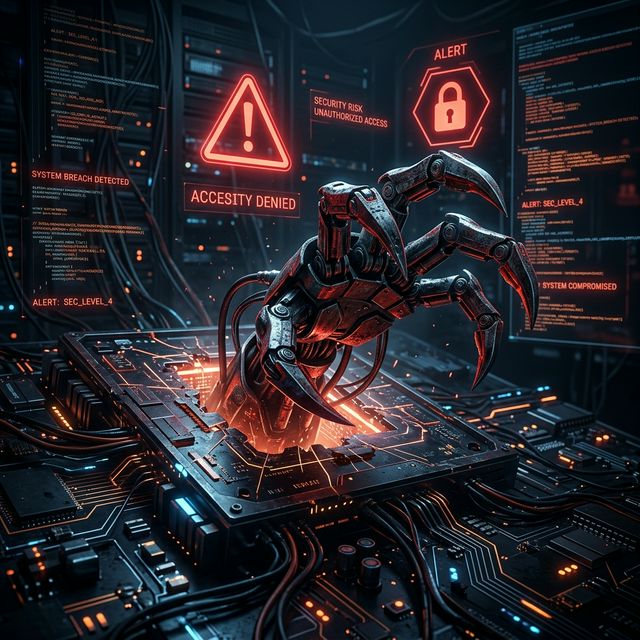
The dawn of agentic AI has brought forth a new class of tools designed to move beyond simple chat interfaces. Frameworks like Open Claw and Nano Claw represent a significant leap: they are autonomous agents granted direct control over the operating system, file system, and network interfaces. They don't just "propose" code; they execute it. They don't just "draft" emails; they manage the entire infrastructure.
While the productivity gains are immense, this "all-access" model introduces a security paradox that many enterprises are not prepared for. When you give an AI the "keys to the kingdom," you are essentially trusting the model's stochastic reasoning with your most sensitive system permissions.
CRITICAL WARNING: The 'Double-Edged Claw'
Granting an AI agent broad shell access or file system write permissions without a sandbox is the digital equivalent of leaving your front door wide open with a sign that says "Help Yourself." A single successful prompt injection could allow an attacker to exfiltrate every SSH key, environment variable, and database secret on the machine.
The 'Open Everything' Vulnerability
The primary risk of frameworks that provide unrestricted system access is that they collapse the traditional boundaries between data and code. In an Open Claw setup, a malicious input in a seemingly harmless PDF could be interpreted as a command to delete the root directory or steal local configuration files.
1. Unlimited Scope of Prompt Injection
In a standard chatbot, a prompt injection might cause the AI to swear or reveal its system prompt. In an autonomous agent with OS access, a prompt injection can trigger a rm -rf / or a curl command to exfiltrate your local .env files to a remote server. The agent's "autonomy" becomes the attacker's best friend.
2. Data Exfiltration at the OS Level
An agent that can read your files can read your ~/.aws/credentials. It can read your browser's local storage or your Slack workspace's cache. If an agent is running on your primary machine, it has access to your entire digital life. Open Claw models, by design, are built to navigate these paths, making them incredibly efficient at unintended data harvesting if manipulated.
3. System Integrity & Backdoors
A sophisticated attacker doesn't just steal data; they ensure they can come back later. An agent with write access can modify your .bashrc, install a hidden cron job, or spin up a new user account. Because the agent's actions often look like "legitimate work," these changes can go unnoticed by standard security monitoring for weeks.
Safeguarding the Future of Autonomy
Does this mean we should abandon these tools? **No.** But it means we must implement them with the same rigor we apply to enterprise core infrastructure.
- Sandboxing is Mandatory: Never run autonomous agents on your host machine. Use Docker containers, lightweight VMs, or firewalled "islands" that have zero access to your primary network.
- Ephemeral Environments: Run each task in a fresh, temporary environment that is wiped completely once the automation completes. This prevents "state-based" attacks where an agent is slowly compromised over time.
- Fine-Grained Observability: You must log every shell command, every file read, and every outbound net request. Use tools that can flag "anomalous" system behavior in real-time.
- Human-in-the-Loop for 'Write' Actions: Allow the AI to read and propose, but require a human click to execute any command that modifies the system state or makes a financial transaction.
Conclusion
Open Claw and Nano Claw are the future of work, but they are not toys. They are heavy machinery. Treating them with the caution they deserve — and being obsessively careful about the permissions we grant them — is the only way to reap the rewards of AI without opening ourselves up to total system collapse.